Why Your Corporate Gift Program is a Hidden Time Sink (And How to Fix It)
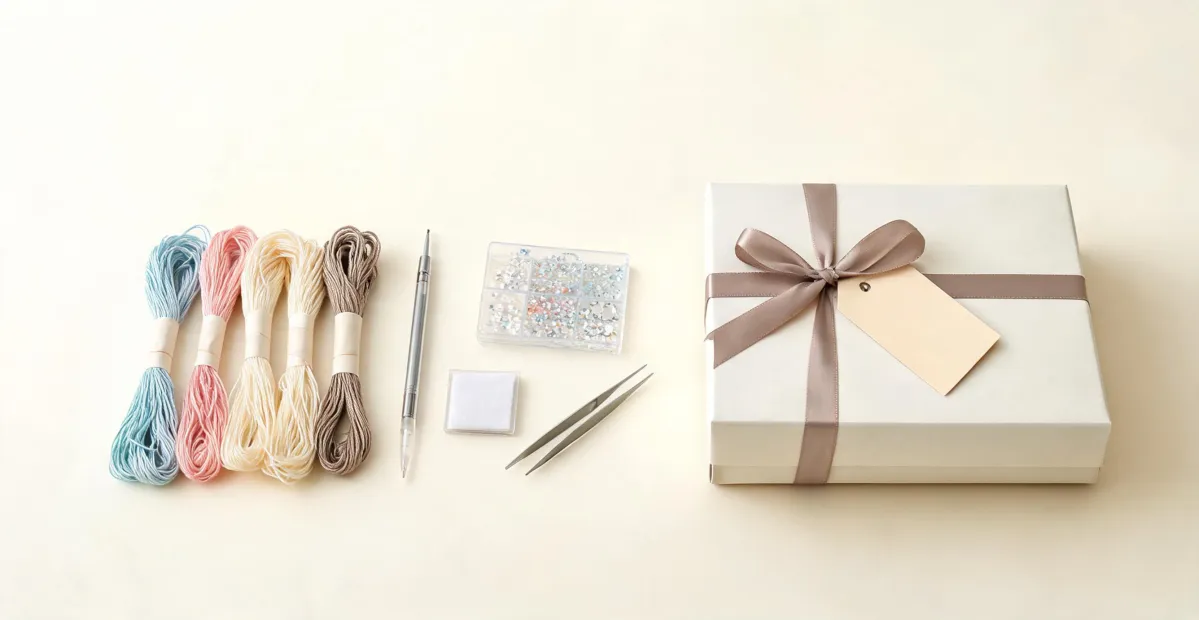
The Box of Random Pins
I've been managing office purchasing for about five years now. When I first started, I thought corporate gifts and promotional items were the easy part. I mean, how hard can it be to order a few embroidered name badges or a set of diamond painting kits? It's just stuff, right?
Fast forward to a Tuesday morning in Q2 2024. I had a VP of Sales standing at my desk, needing 30 custom welcome packages for a client visit the following week. The request: a branded tote with a high-end home fragrance diffuser, a personalized name badge, and a 'fun' insert—something like a cross stitch kit. And it all had to match our new brand colors, which were, of course, a very specific DMC shade.
My initial approach to this was, honestly, a mess. I thought: call one vendor. Give them the list. Done. But my assumption was completely wrong. The vendor who could do the name badge embroidery beautifully had no idea what a DMC color chart for diamond painting was. The supplier for the home fragrance only sold in bulk and didn't do custom branding. And the cross stitch kit specialist had a 6-week lead time.
I learned the hard way that the surface level problem—'I need to order gifts'—hides a much deeper organizational failure.
The Deeply Annoying Truth: It's Not About the Products
Here's what I wish I had tracked from the start. When I compared our Q1 and Q2 results side by side—same vendor requests, different specifications—I finally understood why the details matter so much. The 'gift request' is never just a gift request. It's a multi-headed beast with three distinct heads:
- The Compliance Head: Does this vendor support proper invoicing? Is their DMC color chart accurate to the brand guide? Will the name badge have the correct font and spacing? I once had a vendor who couldn't provide a proper invoice (a handwritten receipt only). Finance rejected the expense report. I ate $400 out of the department budget just to make the VP happy.
- The Logistics Head: Can they handle 60 individual addresses for drop-shipping? Do they have the home fragrance in stock? How long to ship a full set of diamond painting tools?
- The Quality Head: Does the 'intermediate embroidery kit' look like a toy or a professional product? Will the paint by number design actually look like the image? That unreliable supplier who sent blurry printed canvases made me look bad to my VP when the client presentation went south.
My initial misjudgment cost time, money, and a bit of my sanity (ugh). I used to think the solution was just to find a 'better' list of vendors. But really, the problem was that I was treating every request as a new emergency. I had no system.
The Real Cost of the Chaos (A Surprising Math Problem)
I don't have hard data on industry-wide overhead for corporate gifting. But based on managing relationships with about 8 different vendors for these needs, my sense is that the hidden cost of disorganization is enormous. Let's look at the math for a typical custom promotional gifts order.
Example Scenario: Ordering 50 custom 'welcome kits' for new hires, including a name badge, a small embroidery kit, and a branded home fragrance sachet.
- The 'I need it yesterday' premium: We processed about 60-80 orders annually. At least 20 of them were 'rush' because someone didn't plan. Rush fees can add 20-35% to the unit cost. That's a ton of wasted budget.
- The 'oh no, wrong color' cost: If you order from a supplier who doesn't use a standard color reference like the DMC color chart, the embroidery thread on the name badge might be off by two shades. For a sales team, that's a branding violation. Return, re-order, pay shipping twice. The price differential between the 'cheap' quote and the 'quality' quote vanished when you factor in the do-over.
- The 'where is my order?' time sink: Processing 60-80 orders annually with 8 different vendors means 8 separate phone calls, 8 different tracking numbers, and 8 separate invoices to reconcile. This saved our accounting team... wait, no, it didn't save them anything. It cost them about 6 hours of data entry a month.
- For embroidery and cross stitch: Work with a supplier who actually understands your brand's DMC color chart. The DMC Wild Blooms Intermediate Embroidery Kit is a fantastic example of a product that must be sourced from someone who knows the thread numbers. If they don't know DMC, they probably can't guarantee the shade (context dependent, but a safe rule).
- For name badges: This is a high-volume, high-need-for-consistency item. You need a vendor who has a web portal for easy re-orders, supports 18 U.S. Code § 1708 (federal mailbox laws) for direct shipping, and has a clear invoicing system. If they can't produce a standard invoice, run. I've been there (unfortunately).
- For home fragrance and decor: This is a niche. A vendor who says 'we do everything' probably doesn't excel at volatile oils or custom scent blending. I went back and forth between a specialist and a generalist for weeks. The specialist won because of their expertise with DMC standardized color systems (for the diffuser design, not the scent). Generalist had a better price on paper, but the specialist's quality was way better.
So, What Actually Works? (My Hard-Won Advice)
After a particularly bad experience where I had to choose between a specialized name badge vendor (amazing quality, terrible payment system) and a generalist (good price, but their DMC color chart for diamond painting was completely useless), I had an epiphany. The solution isn't to find one vendor that does everything. It's to find the right vendor for each specific problem, and then build a system around that.
Here's what that looks like in practice:
The key takeaway? It's okay to say 'this vendor isn't our strength'. The vendor who told me 'we do embroidery, but home fragrance is out of our depth, here's who we recommend' earned my trust for everything else. I'd rather work with a specialist who knows their limits than a generalist who overpromises.
And for the 'how to display a cross stitch' part of my job? That's a separate system for a separate day. (Circa January 2025, I still haven't fully solved that one, but the principle holds.)
Prices as of January 2025; verify current rates. For more on proper shipping and regulations, check with USPS (usps.com) and FTC (ftc.gov) guidelines on advertising and labeling. This worked for us as a mid-size B2B company with predictable ordering patterns. Your mileage may vary if you're dealing with international logistics or high-volume seasonal demand.

Elise Laurent
Elise Laurent is a crystal and decorative glass quality analyst covering crystal figurines, vases, ornaments, suncatchers, and gift glassware. She examines ISO 6486-1 where food-contact glass dinnerware applies, then uses polarized strain inspection, dimensional checks, surface-defect grading, and refractive clarity to compare decorative pieces outside that scope. Her work helps sourcing teams choose materials, finishing routes, and protective packaging without confusing visual brilliance with verified durability.