Diamond Art vs. Diamond Painting: A DMC Color Chart FAQ for Christmas Ornament & Home Decor Gifts
-
1. Diamond art vs. diamond painting: what's the actual difference?
-
2. What is a diamond painting DMC color chart, and why does it matter?
-
3. What exactly is DMC Christmas green?
-
4. Can you turn DMC craft supplies into Christmas ornament kits for clients and employees?
-
5. Are DIY crafts really home decor now?
-
6. Does a DMC number on the chart mean DMC made the kit?
-
7. What do B2B buyers usually miss when ordering craft kits in bulk?
I'm the office administrator for a 160-person architecture firm, and I've run our purchasing since 2020. That's roughly $90,000 a year in vendor spend—furniture, software, coffee, client gifts, you name it. In August 2024, the managing partner asked me to come up with December gifts that weren't another branded tumbler. That request turned into a deep dive on diamond painting, DMC color charts, and what 'Christmas green' actually means.
I sampled kits from six suppliers and test-assembled twelve of them with two members of our design team. Here are the questions I kept asking, in the order I kept asking them.
1. Diamond art vs. diamond painting: what's the actual difference?
Short version: they're the same craft, but the wording matters when you're sourcing.
Diamond painting is the process of pressing tiny resin 'diamonds' onto a sticky, color-coded canvas. Diamond art is what the finished piece is usually called, and some sellers use it as the category name for anything framed or marketed as decor. There's no official line between the two.
Honestly, I've never found a consistent industry rule for which term applies. My best guess is that 'diamond art' became the online-marketing label for kits positioned as wall decor, while 'diamond painting' stayed attached to the craft itself. When you compare suppliers, search both terms and pay more attention to canvas dimensions and drill shape—square vs. round—than to the label.
2. What is a diamond painting DMC color chart, and why does it matter?
A diamond painting DMC color chart maps color codes—like DMC 699 or DMC 321—to specific dyed shades. DMC is the thread company that built this numbering system for embroidery floss; its history goes back to 1746. Diamond painting kit makers adopted those same numbers to label resin drills, so an embroidery floss color and a diamond drill color can be coordinated across entirely different product lines.
That matters for B2B orders more than you'd expect. When I say it matters, I don't mean the chart is just a nice insert inside the box. If you're ordering canvas kits from one vendor and DMC thread from another, the DMC code is the common language both suppliers share.
It also makes custom gift kits practical. We ordered blank printed canvases and bought floss separately; our designer used the DMC chart to specify exact shades instead of guessing which greens would match the canvas print. That level of consistency is hard to get any other way.
3. What exactly is DMC Christmas green?
DMC Christmas green is the common name for DMC 699. It's the deep, rich green you see in holiday cross-stitch patterns, Christmas ornaments, and seasonal diamond painting kits. If you're sourcing red-and-green holiday kits, DMC 699 is usually the reference point for the green side of the palette.
Here's the practical part: if a supplier labels a shade 'holly green' or 'festive green' but doesn't give you a DMC code, ask for it. A name alone won't help you match a replacement drill or thread six months later. DMC 699 will.
4. Can you turn DMC craft supplies into Christmas ornament kits for clients and employees?
Yes, but the format makes or breaks the gift. A cross-stitch ornament is lovely and personal, but a first-timer can easily spend several evenings on one small design. That's too much for a corporate gift audience. A mini diamond painting ornament—a small, pre-printed ornament-shaped canvas with drills—is a better fit for a client who has maybe an hour to try something new.
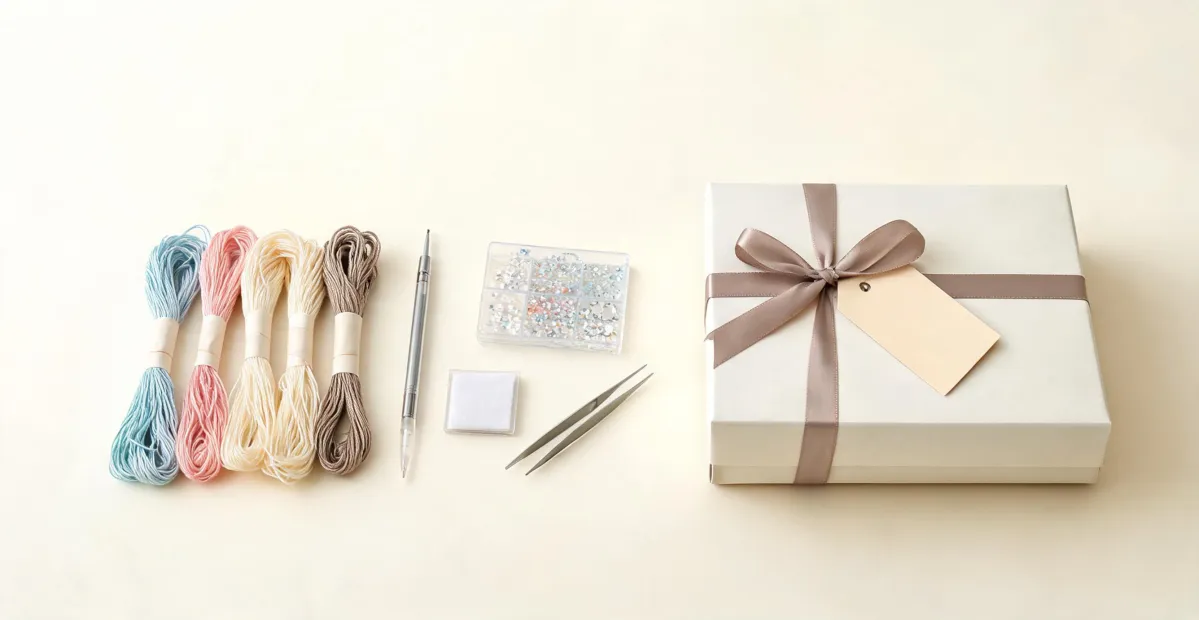
If you're doing an employee event, keep the scope tight: a 3 to 4 inch ornament canvas, labeled drill packs, a plastic needle or stylus, and a simple printed instruction card. We tested full-drill versions with our design team, and they took longer than expected. Sparse designs were far more realistic for a lunch-hour activity.
For our December client program, the winning format ended up being a flat kit: an ornament-shaped adhesive canvas, a small set of DMC-numbered drills, and a pattern card. Flat also mattered for another reason—shipping, which I'll get to below.
5. Are DIY crafts really home decor now?
This is the perception shift I had to work through. Five years ago, DIY craft kits felt like hobby-closet material. The corporate gift lists I saw in 2020 were full of desk objects—mugs, tech accessories, notebooks. But post-pandemic, more gifts were aimed at living spaces, and handmade pieces started showing up as intentional decor: a small hoop on a wall, diamond-painted coasters on a coffee table, a personalized ornament on the tree.
What was best practice in 2020 doesn't always apply in 2025. The fundamentals haven't changed—people have stitched and decorated for centuries—but the execution has. Home decor is now a legitimate positioning for craft kits, not just a bonus if someone happens to like the finished piece.
Our designers made the point clearly: a gift that looks like something you'd display in your home gets kept. A gift that looks like a craft project gets stored in a drawer. That's the difference between 'DIY kit' and 'DIY home decor.'
6. Does a DMC number on the chart mean DMC made the kit?
Not always, and it's worth knowing before you buy in volume. Here's something vendors won't often volunteer: 'DMC-compatible' or 'DMC chart included' generally means the colors follow DMC's numbering system. It doesn't guarantee that DMC manufactured the drills, the canvas, or the floss in the box.
That's not automatically a problem. A lot of independent kit makers use DMC codes as the shared color language, and some of them do excellent work. But the label alone doesn't tell you which one you're getting. In our sample order of twelve kits from six suppliers, three had charts where the printed DMC code didn't match the color of the drills in the bag.
I don't have hard data on how often that kind of mismatch happens industry-wide. What I can tell you is that two of the three suppliers fixed the issue quickly once we sent photos, and one didn't. Order a pre-production sample before you commit to a large quantity.
7. What do B2B buyers usually miss when ordering craft kits in bulk?
Most corporate buyers focus on per-unit pricing and completely miss the three costs that show up later.
First, shipping form factor. A flat kit can move through the mail at a much lower rate than a bulky or rigid one. According to USPS rates effective January 2025, the first ounce of a First-Class Mail letter is $0.73, and a one-ounce large envelope starts at $1.50 (see usps.com/stamps). Once you add a wooden ornament base, a glass dome, or a rigid frame, you're in package territory, and the per-unit shipping math changes completely. Ask suppliers for packed dimensions and weight before comparing quotes.
Second, invoicing. One vendor in our comparison offered a significantly lower price, but they couldn't provide a proper invoice—just a handwritten-style receipt. Finance rejected the expense, and the cost landed on my department's budget anyway. Now I verify invoicing capability before I place any PO, no matter how good the price looks.
Third, sample-to-production consistency. The sample that wins the bid is not always the production run you receive. With craft kits, the risk isn't just visual; it's color codes. A chart misprint might not show up in a product photo, but it will show up the moment a recipient opens the kit and the 'DMC 699' drills look closer to DMC 704. Build QC time into your project plan.
If you're ordering kits for a holiday program, leave room for one extra round of samples. It's cheaper than discovering a color mismatch after boxes have gone out to two hundred client addresses.

Elise Laurent
Elise Laurent is a crystal and decorative glass quality analyst covering crystal figurines, vases, ornaments, suncatchers, and gift glassware. She examines ISO 6486-1 where food-contact glass dinnerware applies, then uses polarized strain inspection, dimensional checks, surface-defect grading, and refractive clarity to compare decorative pieces outside that scope. Her work helps sourcing teams choose materials, finishing routes, and protective packaging without confusing visual brilliance with verified durability.