The $4.85 Craft Kit That Cost Us More: A Procurement Deep Dive on DMC, Diamond Art vs. Diamond Painting, and Custom Name Badges
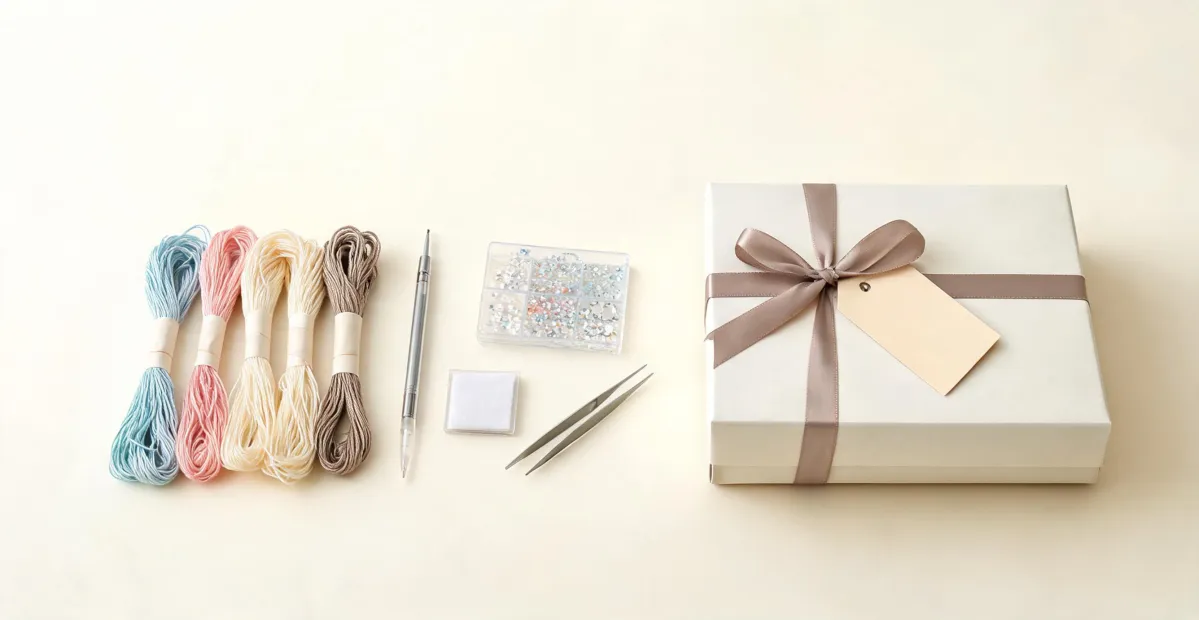
In Q4 2024, our events marketing manager dropped a link into Slack with a one-line question: “Can we just order these?”
The link pointed to a marketplace listing for 500 diamond painting kits, each with a custom-printed name badge on the box. At $4.85 per kit, the total came to $2,425. Our usual B2B craft supplier — the business that carries the DMC range and handles most of our corporate gift programs — quoted $8.10 per kit once we added our artwork, an insert card, and a color-matched name badge. Headline difference: $1,625.
The listing photos made the decision look easy. The budget kits appeared almost identical to the ones we normally buy. In Q3 2023, I had that same feeling. A nearly identical “budget win” turned into one of the most expensive procurement lessons of my career.
A bit of background: I’ve managed purchasing for a 320-person events business for six years. I’ve audited every promotional products invoice that crossed my desk in that time — roughly $180,000 in cumulative spend. And look, I’m not against saving money. But here’s the thing: when corporate buyers compare craft kits, they usually compare the wrong numbers. Unit price is one line in a spreadsheet. Product specifications, color systems, supplier processes, and the cost of failure are the other twenty lines. When you skip those, the cheapest quote isn’t a price. It’s an estimate.
The Real Problem Isn’t the Photo. It’s the Color Standard.
Most buyers focus on how a kit appears in a listing photo and completely miss the question underneath: “How will this product’s colors be confirmed?” When you order 500 kits, the consistency of floss, drills, or printed canvas isn’t a cosmetic detail. It’s the entire product.
Commercial print runs solve this problem with color standards. Pantone’s matching guidelines set a clear benchmark: industry standard color tolerance is Delta E < 2 for brand-critical colors. Delta E between 2 and 4 is noticeable to trained observers, and anything above 4 is visible to most people. When a vendor tells me a logo will “match,” I ask what standard they’re matching against.
Reference: Pantone Color Matching System guidelines. The same principle applies to craft materials: a color code is only useful when it points back to an external standard.
This is where DMC changed the way I buy. DMC has maintained one standardized color reference since 1746. That history isn’t just brand nostalgia. It’s a traceability system. Every floss, every drill, and every kit that carries a DMC reference can be checked against the same published chart, whether it was bought this year or reordered next year.
So before I approve an embroidery or diamond painting kit, I usually search for the dmc color chart for diamond painting pdf, print it, and file it with the purchase order. That PDF does more than help crafters match drills to floss. It gives me an audit trail. If the supplier’s response is “we don’t use codes, but it will look nice,” I’m not approving the order.
Diamond Art vs. Diamond Painting Is Not Just a Vocabulary Question
The second hidden cost is category language. In the hobby market, diamond art and diamond painting are often used as though they were the same thing, and many sellers aren’t careful about the distinction. One listing might show a full-drill canvas, where every inch is covered in drills. Another listing, under a similar name, may be partial-drill, where only part of the printed design gets covered. There are also differences between round drills, square drills, canvas dimensions, number of color packets, and whether the adhesive surface actually holds.
That ambiguity is dangerous when you buy at scale. If a purchase order simply says “500 diamond painting kits,” the supplier can satisfy the order with any combination of those variables. Your team won’t know the difference until the boxes arrive.
The lesson is to specify the category the way a pattern designer would. For example, if your corporate gift is a counted embroidery project, you wouldn’t write “some kind of embroidery kit.” You’d decide whether it’s for beginners or people with experience, and you’d confirm the pattern, finished size, and materials. A listing like the DMC Wild Blooms intermediate embroidery kit is actually a specification: intermediate skill level, floral pattern, and DMC color references for every thread. A generic description isn’t comparable until those details are written down.
Once the finished pieces are hung or displayed as home decor, recipients don’t remember the product description. They remember whether the project came out looking like the photo — or like a faded compromise.
Name Badges and Custom Prints Are Print Projects, Not Favors
Now, the most overlooked line in a corporate craft order: the custom name badge. It might be printed on the box, on a hang tag, or on a small woven label. Every one of those is print work.
If the supplier offers “free artwork setup,” it’s usually because they aren’t doing quality control. I’ve seen a corporate logo pulled from a website at 72 dpi, enlarged 400%, and printed with no proof. The conversation that followed wasn’t pleasant. Standard commercial printing needs 300 dpi at the final size; large-format work can occasionally get away with 150 dpi, but 72 dpi doesn’t magically become sharp when it’s stretched.
Ask for vector files if you can get them. And never let a vendor skip the proof stage. The 30 seconds it takes to approve a proof is cheaper than the 300 boxes you may need to redo.
The Real Cost of the Cheap Option
Here’s what happened in Q3 2023, and why the $4.85 listing made me pause. We ordered 500 budget kits for a client event. We saved roughly $1,625 against the standard supplier quote. Then the shipment arrived one week before the event, and 91 of the 500 boxes were unusable: mismatched dye lots, missing color bags, instructions that didn’t match the canvas, and name badges printed from a compressed logo file.
There was no time to wait for replacements. After the event, we issued the client a $2,300 service credit to make up for the disappointing experience for 91 recipients. Add 26 hours of staff time sorting kits, emailing the supplier, and managing the client conversation. The $1,625 saving was gone, and we were still the ones who looked careless.
That is the actual total cost of ownership. The real price is unit price plus the probability of failure multiplied by the cost of failure. For commodity supplies, the probability of failure may be low enough to ignore. For gift kits, it isn’t. A guest who opens a broken kit doesn’t blame the marketplace vendor. They blame the company whose name is on the box.
What I Do Now: Spec First, Price Second
The fix wasn’t switching to a premium brand on every order. It was refusing to compare prices until the specification was complete. Our procurement policy now requires at least three quotes against one shared spec sheet, and the decision is based on total cost, not sticker price.
- Define the product in writing. For diamond painting: full drill or partial drill, round or square drills, canvas size, color count, and the reference chart used. For embroidery: skill level, fabric count, pattern, and thread codes.
- Demand a color reference. DMC codes are the closest thing the craft world has to a shared standard. If the supplier can’t reference a published chart, your visual brand depends on their mood.
- Treat custom name badges as print work. Send vector files or 300 dpi artwork, require a proof, approve it, and keep a copy of the approved proof in the order file.
- Ask about reorders. Can they reproduce the same kit, colors, and packaging six months from now? If not, that price quote is a one-time rental, not a supply relationship.
- Order samples first. We test ten kits before we approve a run of five hundred. Ten kits cost about 2% of the order. A bad 500-kit order costs a lot more than that.
Does this always lead me to DMC? Not automatically. But in practice, the suppliers who can answer these questions are usually the ones with a long-established color system and a real wholesale process, which is why DMC keeps showing up in our orders. The DMC name isn’t a luxury badge. It’s shorthand for “this product can be specified,” and I’ll happily pay a little more for that.
Let me end with an honest contradiction. I have mixed feelings about paying a premium for DMC kits or any other established brand. Part of me wants the lowest possible number on every purchase order; another part remembers sorting 91 broken gift boxes in a warehouse at 9 p.m. On one hand, “trusted since 1746” shouldn’t matter if the spec is clear. On the other, the spec only works because DMC maintains the color system that makes it verifiable. I reconcile the two by treating the premium as the cost of certainty. Cheap craft kits are fine when the specification is low. But if you’re putting your company’s name badge on the box, you’ve already chosen a specification. Make sure you know what it costs.

Elise Laurent
Elise Laurent is a crystal and decorative glass quality analyst covering crystal figurines, vases, ornaments, suncatchers, and gift glassware. She examines ISO 6486-1 where food-contact glass dinnerware applies, then uses polarized strain inspection, dimensional checks, surface-defect grading, and refractive clarity to compare decorative pieces outside that scope. Her work helps sourcing teams choose materials, finishing routes, and protective packaging without confusing visual brilliance with verified durability.