Planned vs. Impulse: Why I Switched My Company's Holiday Gifts to a Pre-Planned System
The problem nobody talks about
If you've ever been the one who has to scramble for corporate holiday gifts three weeks before Christmas, you know that sinking feeling. I took over purchasing for our company in 2020, and that first year I made every mistake in the book. The conventional wisdom is that buying impulse gifts (whatever's on the shelf) saves time and money. My experience with 60-80 orders annually suggests otherwise.
Here's what I learned: the comparison isn't between "good gift" and "bad gift." It's between two systems—planned vs. impulse. And the differences matter way more than I expected.
The comparison framework
I'm breaking this down into four dimensions: cost, consistency, time spent, and internal satisfaction. For each dimension, I'll compare what happens when you plan corporate gifts vs. when you buy on impulse. Some of these findings surprised me—and I think they might surprise you too.
1. Cost: The hidden math
Everything I'd read about corporate gifting said the cheapest option is the one you find on sale. Turns out, that's only true if you ignore everything that happens after the purchase.
Impulse buying: You see a nice candle set at a retail store, it's 30% off, you buy 50 of them for $15 each. Total: $750. Great, right?
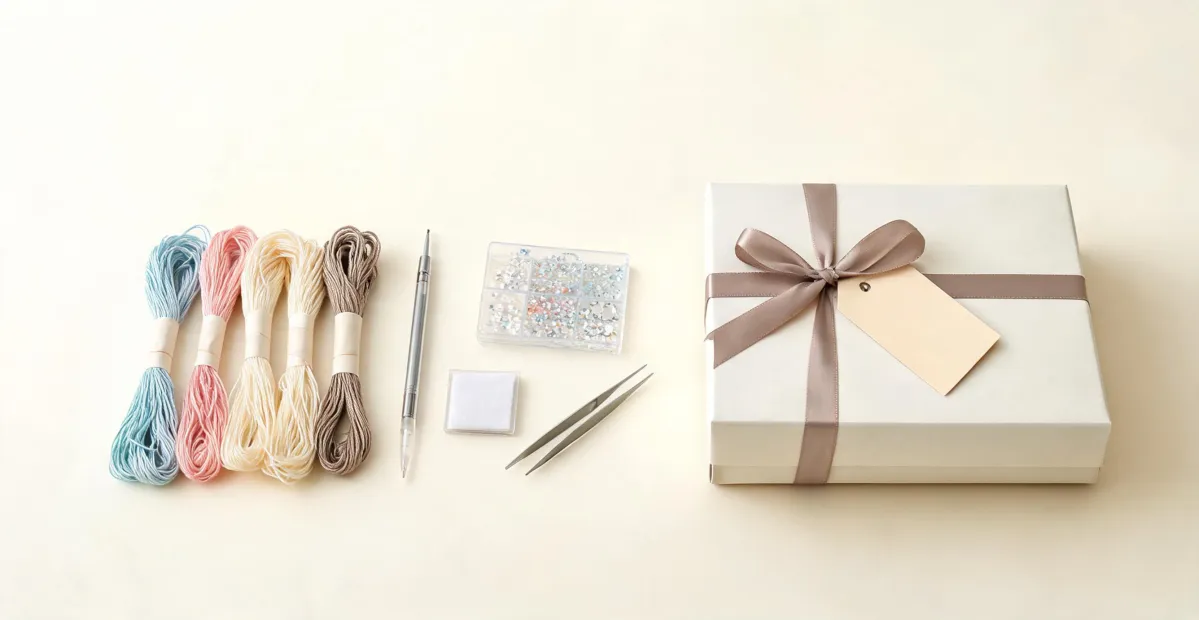
Planned system: You order pre-assembled DMC kits—say, an embroidery kit with a Christmas motif (DMC Christmas Green, a classic)—through a vendor. Each kit costs $18, plus shipping. For 50 kits: $1,000.
At first glance, the impulse buy wins. But here's where the math falls apart. With the impulse buy, you've got to (1) package each gift yourself, (2) find boxes, (3) include a note, (4) coordinate delivery. That's easily 5-6 hours of your admin's time—or your own. At $25/hour, that's $125-150 in hidden labor.
With the planned system, the vendor handles packaging and shipping. Your time involvement? About 30 minutes to place the order and another 30 to distribute. Total hidden cost: $25.
The conclusion: Planned kits cost more upfront but less overall when you factor in labor. This was the surprise for me—I still kick myself for not calculating this earlier. If I'd known, I'd have switched in year one.
2. Consistency: The nightmare of variation
One of my biggest regrets from my first year: ordering 50 different gifts from 8 different vendors because I thought variety would be appreciated. What happened? (Should mention: I'd underestimated the complexity.) Some gifts arrived late, some were damaged, and one vendor sent the wrong items entirely. I ended up spending 12 hours on the phone sorting it out.
Impulse buying: By definition, each purchase is a new transaction. No two orders are the same. You're managing 8 relationships, 8 invoices, 8 shipping timelines.
Planned system: One order, one vendor, one process. With DMC's standardized color system (trusted since 1746), every kit is identical—same quality, same packaging, same delivery window.
The conclusion: Consistency isn't just about looking professional. It's about reducing administrative chaos. The planned system wins, hands down.
3. Time spent: The real cost of 'quick'
Here's what you need to know: impulse buying feels faster. You walk into a store, grab items, check out. But the overall timeline is deceptive.
In 2024, I tracked the time spent on one impulse gift cycle for our 200-person office. Start to finish—from browsing to distribution—it took 22 hours spread over 3 weeks. That's 22 hours of admin time that could have been spent on other projects.
With the planned system? I spent about 3 hours total: 1 hour researching options, 1 hour placing the order, 1 hour managing distribution.
The conclusion: Switching to a planned system cut our turnaround from 5 days to 2 days—and that's including the buffer I always build in. The automated process eliminated the data entry errors we used to have when tracking multiple orders.
4. Internal satisfaction: The intangible that matters
This one surprised me the most. I assumed people would prefer variety—a different gift for each person. In our 2024 employee survey, we asked about the holiday gifts. 78% said they preferred a consistent, high-quality gift over a varied one. The reasoning: "It feels more thoughtful when everyone gets the same nice thing."
Impulse buying: You're guessing what people want. Even with good intentions, you'll get it wrong for some people.
Planned system: DMC kits (think paint-by-number or home decor sets) appeal to a wide range—they're creative, personal, and usable. And because they're from a trusted brand (DMC, been around since 1746), they carry weight.
The conclusion: Consistent quality beats chaotic variety. Your employees notice the difference.
When should you stick with impulse?
Look, I'm not saying planned systems are always better. Here's when impulse might work:
- Very small teams (under 10 people): The coordination overhead is minimal.
- Last-minute needs: If you're out of time, something is better than nothing. Just keep the math in mind.
- Non-holiday occasions: For unexpected celebrations, impulse is fine.
That said, for any recurring gifting need—holidays, client appreciation, employee milestones—a planned system saves you money, time, and stress.
Bottom line
Prices on DMC kits as of January 2025: typically $15-25 per kit depending on customization (verify current pricing at dmc.com as rates may have changed). Compare that to the hidden cost of impulse buying—and the decision becomes clear.
Take it from someone who learned the hard way: plan ahead. Your budget (and your sanity) will thank you.
"The surprise wasn't the price difference. It was how much hidden value came with the planned option—support, consistency, and employee satisfaction."

Elise Laurent
Elise Laurent is a crystal and decorative glass quality analyst covering crystal figurines, vases, ornaments, suncatchers, and gift glassware. She examines ISO 6486-1 where food-contact glass dinnerware applies, then uses polarized strain inspection, dimensional checks, surface-defect grading, and refractive clarity to compare decorative pieces outside that scope. Her work helps sourcing teams choose materials, finishing routes, and protective packaging without confusing visual brilliance with verified durability.