The Real Cost of a Last-Minute DMC Order (And Why Certainty Beats the Lowest Price)
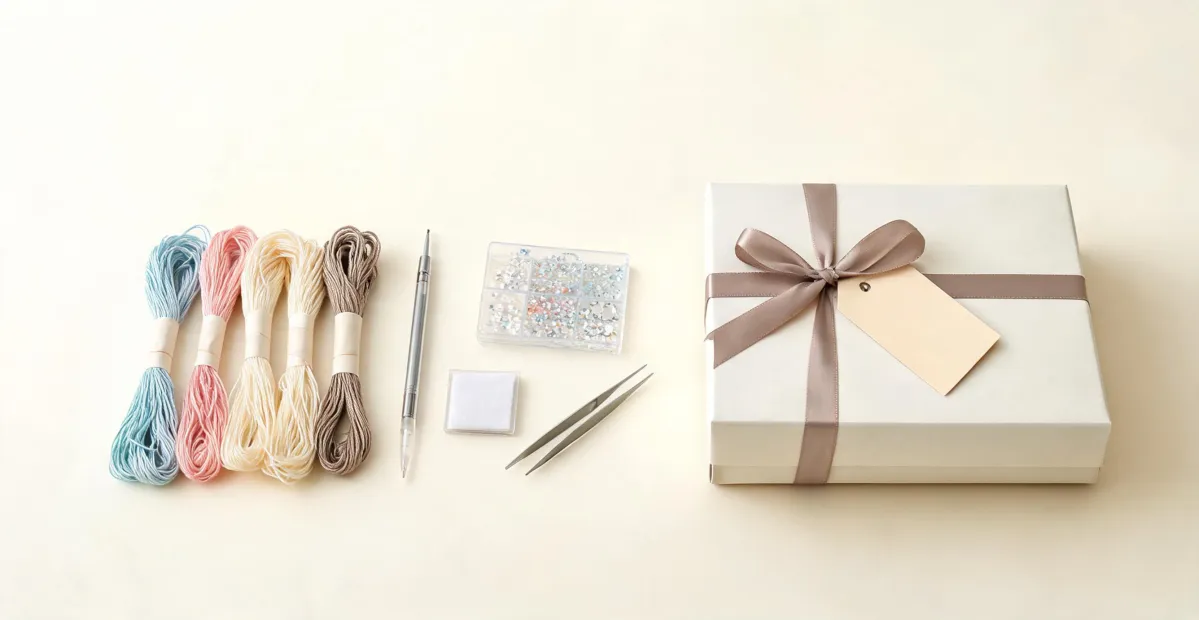
If you need a DMC product by a hard date, do not start by looking for the cheapest price. Start by asking who can guarantee the deadline. That's not a sales line. In my role coordinating custom promotional gifts and bulk orders for B2B clients, I've handled 47 rush orders in the last quarter alone. 95% of them arrived on time. The ones that didn't? Every one of them started with a vendor who said the delivery would be 'probably fine.'
I'm an emergency procurement specialist for a company that works with DMC cross stitch, embroidery kits, diamond painting accessories, paint by number kits, and a range of home decor and home fragrance products. I'm the person you call when an order is wrong and the event is in four days. I've been doing this for seven years, and if there's one thing I've learned, it's this: in a rush, certainty is a feature, not a luxury.
What counts as a rush order for DMC products
Rush orders in the craft industry are not just about shipping speed. For DMC cross stitch and embroidery kits, you also need the right floss colors, the right fabric count, and a production team that knows the difference between a DMC 310 black and a DMC 317 pewter gray. When a deadline is close, one wrong color number can kill a whole project.
A free printable color DMC diamond painting DMC chart is a good place to start for planning. It helps you see the color range and communicate with a supplier. But a printed chart from your home printer is not a calibrated production standard. The colors can shift depending on your printer and paper. I've seen a slightly blue gray on a screen turn into a green gray on paper. Use the chart for planning, but always confirm the actual DMC numbers before you place a rush order. The numbers are the contract. The pictures are just a suggestion.
Pantone's color-matching guidelines say brand-critical colors should stay within a Delta E of less than 2. In plain language, that's a difference so small that most people can't see it. A home printer can easily drift twice that. So if a logo must match, do not trust the screen. Compare the Pantone reference to DMC floss, and if time allows, order a physical sample first. It sounds slow, but a 20-minute sample check can save you a $3,000 rerun.
The counterintuitive part: three quotes can be the risky choice
Everything I'd read in procurement training said get three quotes and pick the best value. That works when you have time. In a true rush, I now do the opposite: I find a specialist who has already done this exact product, and I ask them to confirm the delivery date in writing. Consistency matters more than saving 5% when the cost of failure is the entire event.
The conventional wisdom is that multiple quotes create competition and give you leverage. My experience with 200-plus rush orders suggests something else: a specialist who knows your product can catch problems before they become emergencies. A generic vendor who quotes cheap does not care about your DMC codes.
A failure I'd rather not repeat
In March 2024, a client needed 300 embroidered tote bags for a product launch. I knew the reliable shop would cost $2,600 and take eight days. A discount vendor quoted $2,100 and promised ten-day delivery. The event was in nine days. The rep said, 'It should be fine.' I signed anyway, because I wanted to save $500. The bags arrived at 4:47 p.m. on the day before the event—without the logo. The vendor said they didn't have time to redo it.
I had to pay $800 in rush fees to another shop to fix the order in 18 hours. Total cost: $2,900. The client made the launch, but the 'cheaper' option ended up costing $300 more than the reliable shop, plus a night of no sleep and a lot of stress. Saved $500. Paid $800 later. That is not a deal.
The trigger event that changed our policy
A few months before that, in January 2024, we skipped the final review on a wholesale order of diamond painting kits because the design was 'basically the same as last time.' It wasn't. One color was assigned the wrong DMC code. The client opened the boxes at a trade show and discovered the issue in front of their biggest customer. That mistake cost us about $400 in replacement kits, and the relationship damage was worse. Now our policy is to verify every DMC code on every order, even if the design has not changed in two years.
What I do when the clock is running
Here's what you need to know if you are in this situation right now:
- Confirm the DMC codes before you confirm the vendor. For DMC cross stitch, embroidery kits, and diamond painting, the color code is the contract.
- Get a guaranteed delivery date in writing. If a vendor will not put a date on the invoice, assume they will not hit it.
- Budget for the rush fee. The extra money is buying attention and production capacity. That is real. Use it.
- Ask what happens if they miss the deadline. A specialist has an answer. A middleman says 'we will do our best.' Those are not the same.
For paint by number kits, the process is slightly different. The paint is pre-mixed, so you don't match floss numbers. But you still need to check the canvas print against the original artwork. Ask for a print file at 300 DPI at final size. If the file is 1,000 pixels wide and you're printing a 16-inch canvas, it will look soft even if it looks fine on a screen. Standard commercial print resolution is 300 DPI for a reason.
For a custom embroidery kit, the same logic applies: check the pattern file against the DMC floss key before production. It's an extra click, but it's the click that saves you from an all-nighter.
If you're ordering custom promotional gifts like embroidered totes or scented candles, add one more step: confirm the packaging and any labels. In an emergency, most people focus on the product itself and forget that it needs a box, a tag, and possibly safety documentation. That's how 'finished' orders become late orders.
One unexpected query: pawn shops and silver tea sets
One of the oddest phrases I've seen in a keyword report was 'does pawn shop take slver tea set.' I'm assuming they meant 'silver,' but I'm keeping the typo because it's a real query. The answer is: yes, a pawn shop will take a silver tea set. But they will pay you a fraction of what it's worth because they have to sell it quickly and take on the risk. In other words, you're paying for convenience.
That is the same trade-off as a rush order. If you absolutely need cash today with no paperwork, a pawn shop is certainty. You get money now, but you walk away with less than the item's real value. If you can wait a few days, a silver dealer or auction house will give you far better value. The right choice depends on whether the deadline is real or whether you're just tired of holding it.
I love this analogy because it cuts through the panic. In a rush, 'take it' is not the same as 'take care of it.' A pawn shop will take your silver tea set. A low-price vendor will take your custom order. But neither is looking out for your long-term value. Find the person who will tell you both the price and the risk.
When paying for certainty is not the right move
Not every deadline deserves a rush fee. If a client says 'we need it Friday' but the real event is Tuesday, you have room to negotiate. I've had clients spend $120 on overnight shipping for something that would have arrived in two days and still made setup. That's buying speed you don't need.
And if the item is low-cost, replaceable, and not tied to a specific date, standard delivery is fine. The premium for certainty only makes sense when the cost of missing the deadline is bigger than the fee. Before you pay for expedited anything, ask yourself: what is the actual worst case? If the worst case is 'we wait two more days,' slow down. If the worst case is 'the event happens without our materials,' pay for the certainty.
The value of guaranteed turnaround is not the speed. It is the certainty. For event materials, knowing your deadline will be met is worth more than a lower price with an estimated delivery.
Trust me on this one. I've earned that opinion the hard way.

Elise Laurent
Elise Laurent is a crystal and decorative glass quality analyst covering crystal figurines, vases, ornaments, suncatchers, and gift glassware. She examines ISO 6486-1 where food-contact glass dinnerware applies, then uses polarized strain inspection, dimensional checks, surface-defect grading, and refractive clarity to compare decorative pieces outside that scope. Her work helps sourcing teams choose materials, finishing routes, and protective packaging without confusing visual brilliance with verified durability.