The $1,400 Lesson: Why Cheap Craft Kits Are Bad for Your Brand
-
What does DMC mean in cross stitch? It changed how I buy
-
It's never just a name badge
-
What the 'cheap' quote actually cost us
-
Paint by number kits are a trust test
-
How to preserve a diamond painting is a procurement question
-
Quality is your brand, even in the fine print
-
Quality is not a premium feature
When I first started as procurement manager at a 28-person promotional products company, I made the mistake most new buyers make: I optimized for unit price. I'm not proud of that. It took about three years—or rather, closer to four—and a lot of rework before I learned the difference between price and cost.
If you ask me, the quality of what you hand a client is the quality of your brand. You don't have to buy the most expensive option. But you do have to stop pretending that a lower quote means a lower invoice.
I've managed our sourcing budget—around $450,000 a year for six years—and I've negotiated with 40+ vendors. Every order goes into our cost tracking system. When I say 'cheap is expensive,' I don't mean it as a slogan. I mean it across roughly 1,400 orders. Maybe 1,300; I'd have to check the system.
What does DMC mean in cross stitch? It changed how I buy
Early in my career, a customer asked me: 'What does DMC mean in cross stitch?' I didn't know. I found out that DMC stands for Dollfus-Mieg et Compagnie, a French textile company that's been around since 1746. More importantly, DMC's color system is the shared language of embroidery. When a pattern says DMC 310, every stitcher in the world knows exactly which black that is.
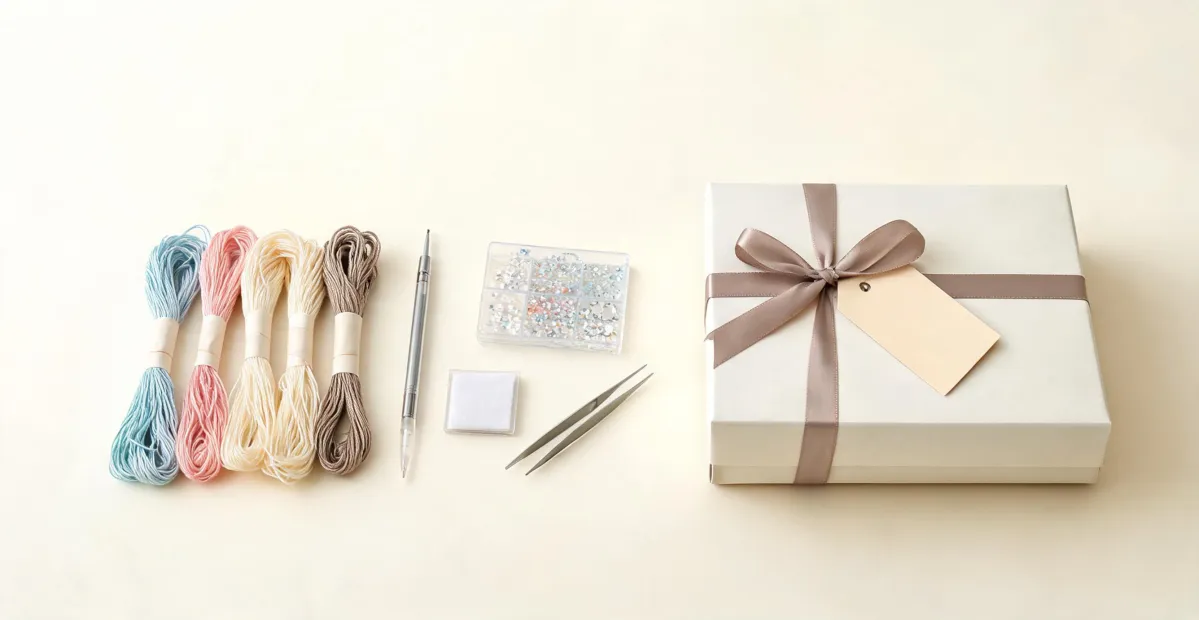
That's why I now specify DMC cross stitch thread in our embroidery kits. Not because it's the most expensive, but because it's standardized. If a kit arrives with off-brand, unlabeled floss, the stitcher has to guess. Guesswork turns a relaxing hobby into a frustrating project. And if our client's name is on the box, guesswork reflects on them.
Standardization also saves money. On a purchase order, 'DMC 310' is a complete specification. That means fewer emails, fewer samples, fewer mistakes. When we used unbranded floss, we had to send color swatches back and forth and sometimes redo entire embroidery batches. That's not a creative cost. That's a procurement failure.
It's never just a name badge
A few years ago, we ordered custom name badges for a corporate event. The samples looked fine on screen. In reality, the laminate peeled within an hour, and the pin backs bent by lunch. Our client didn't complain. They just didn't reorder. That's the silent cost that no spreadsheet caught.
A name badge sits on someone's chest for eight hours. If it looks temporary, so does the company that chose it. The same logic applies to every branded product, from home decor to home fragrance to diamond painting accessories.
And yes, shipping costs matter. For small mailings, USPS rates as of January 2025 are useful to budget: a First-Class Mail letter is $0.73, a large envelope is $1.50, and each additional ounce for large envelopes is $0.28 (source: usps.com). But I've learned to track what's inside the envelope, not just the postage.
What the 'cheap' quote actually cost us
Here's a concrete example from our cost tracking system. We needed 500 embroidery kits for a client. Vendor A quoted $6.80 per kit, including setup, color matching, and freight. Vendor B quoted $5.90. I almost went with B. Then I read the fine print: $250 setup, $0.40 per kit for color matching, and $180 freight. That's $3,580, not the $2,950 the unit price suggested. Vendor A's $6.80 included everything: $3,400 total. B still came out $180 cheaper on paper.
But the paper was wrong. B's thread colors weren't matched to the DMC standard. The client's logo looked distinctly off. We had to redo 80 kits. The redo cost $1,400—no, $1,200 plus $200 in rush shipping, I'm mixing it up with the other project. Either way, the 'cheap' vendor ended up costing us about 40% more than Vendor A.
It's tempting to think you can just compare unit prices. But identical specs from different vendors can result in wildly different outcomes. Most buyers focus on per-unit pricing and completely miss setup fees, color-matching charges, and freight. The question everyone asks is 'what's your best price?' The question they should ask is 'what's included in that price?'
Our procurement policy now requires quotes from at least three vendors, but we compare TCO, not unit price. I built a cost calculator after getting burned on hidden fees twice.
Paint by number kits are a trust test
Paint by number is one of our biggest categories, and it's a perfect example of quality hiding in the details. A cheap paint by number kit can have cracked paint pots, a blurry canvas, and a brush that sheds. The customer doesn't blame the manufacturer—they blame the company that gave them the gift. If you're selling a product that's supposed to be a relaxing creative experience, the last thing you want is frustration.
We now specify canvas weight, paint opacity, and brush quality in our purchase orders. It costs a little more. It's worth it.
How to preserve a diamond painting is a procurement question
When our customers started asking how to preserve a diamond painting, I did the research. The honest answer is: it depends on the quality of the canvas, the adhesive, and whether the drills are sealed. A poor-quality kit loses drills within months. A better kit with a simple sealant and clear instructions can last for years.
I also learned that 'how to preserve a diamond painting' is a search phrase with a lot of questionable advice. Some say hairspray. Some say craft glue. The safest answer is to seal the surface with a product designed for diamond painting, keep it flat while the sealant cures, and frame it without bending the canvas. If we're going to put our client's logo on a kit, we should include instructions that aren't a gamble.
That's why our custom diamond painting kits now include a small tube of sealant and an instruction card. Does it add to the unit cost? Yes. Does it make the finished piece look better? Usually. Over six years, I've learned that the options worth keeping are the ones you'd defend with a straight face.
Quality is your brand, even in the fine print
Quality isn't just in the product. It's in the packaging, the instructions, and the environmental claims. Per FTC Green Guides, if you label something 'recyclable,' you need to be able to substantiate it (source: ftc.gov). A cheap composite blister pack that says 'recyclable' without proof is both a compliance risk and a trust risk. If your client discovers that you overstated the claim, the damage to your reputation is far bigger than the cost of better packaging.
Ask your vendor for documentation. A short email asking 'Can you confirm this claim?' can save you from a compliance headache.
Quality is not a premium feature
You might think this approach only works for companies with generous budgets. That's not what I'm saying. I'm saying you should stop treating unit price as the whole story. A $0.50 difference per kit can look smart in a spreadsheet and cost you a client in the long run.
From my perspective, quality is not a premium feature. It's the baseline. Whether it's DMC cross stitch thread, a custom name badge, a paint by number canvas, or a diamond painting sealant, the person who opens the box is forming an opinion about your company. That opinion is your brand image. It's also the revenue you lose when they don't reorder.
I've made expensive mistakes. I've also fixed my process. If you ask me, the cheapest thing you can buy is a reputation for caring about the details.

Elise Laurent
Elise Laurent is a crystal and decorative glass quality analyst covering crystal figurines, vases, ornaments, suncatchers, and gift glassware. She examines ISO 6486-1 where food-contact glass dinnerware applies, then uses polarized strain inspection, dimensional checks, surface-defect grading, and refractive clarity to compare decorative pieces outside that scope. Her work helps sourcing teams choose materials, finishing routes, and protective packaging without confusing visual brilliance with verified durability.