A $250 DMC Diamond Painting Order Taught Us More Than a $15,000 One
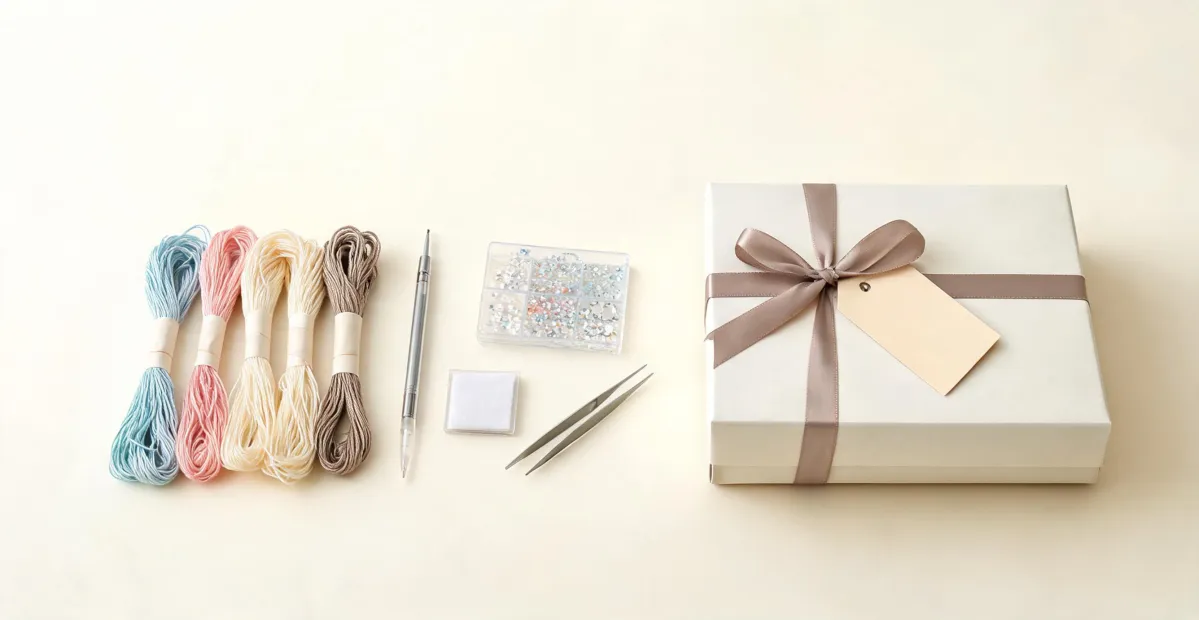
It was a Tuesday afternoon in March 2024, and I was already up against a deadline. Then the phone rang. A craft shop owner named Maya had found our website through a search for "DMC diamond painting color chart." She needed 50 custom diamond painting kits for a craft fair in five days. Her total budget? $250.
Our normal minimum is $1,000. In most companies, a call like that gets a polite no. Honestly, I was about to say "we can't make money on that." But I've seen what happens when you dismiss small orders. Two years earlier, a $300 order from a woman who turned out to run a chain of six stores almost went to a competitor. So I said yes.
The First Mistake: Trusting a Supplier's "Same Specs"
Everything started out smooth. We had Maya pick four DMC shades from our current chart—she wanted muted tones that matched her brand. Then we sent the artwork to a local print shop to produce the color cards for each kit. I assumed "same specifications" meant same colors. Didn't verify. Turned out each vendor has a slightly different interpretation of "DMC 434" depending on their printer profile.
When the cards arrived, the browns were too warm and the greens looked muddy. For a product that's literally about color, that was a deal-breaker. Maya would have a table full of charts that didn't match the actual diamond drills. We had 48 hours until her shipment should go out.
While I was pulling the chart, I also printed out a DMC cross stitch color card because she mentioned her next project was refilling her cross stitch aisle. Her shop serves both diamond painters and cross stitchers, and she wanted to be ready for both.
Decision Time: The Rush Print
We had about 2 hours to decide whether to ship the inaccurate cards and hope no one noticed, or pay for a rush reprint. Normally I'd get three quotes and compare. There was no time. I went with our usual printer—the one that had screwed up the first run—based on trust alone. In hindsight, that seems dumb. But I knew the production manager and he promised to pull an all-nighter. That was good enough for me.
Looking back, I should have insisted on a hard proof before the original print run. At the time, we trusted the vendor's claim because they'd done our large orders before. That was a $250 lesson.
A Realization: Nobody Knew How to Mount the Finished Piece
While the new cards were being printed, Maya called again. A customer had asked her whether the kit came with instructions for mounting the diamond painting to a wooden frame. Maya didn't know. We don't always include a mounting guide for small custom orders—we assume hobbyists already know. That was another wrong assumption.
So I created a one-page "how to mount a diamond painting" sheet: remove the protective film, place the canvas on a flat board, use adhesive or staple the edges if you're going to stretch it, and seal it with a protective film. Honestly, it wasn't rocket science. But it was the kind of missing detail that makes a small customer look bad in front of her own customers. We printed 60 copies with the corrected DMC chart.
The Color Count Question
Maya also wanted to answer a FAQs section on her website: "how many DMC colors are there for diamond painting?" I checked our current chart. According to our official DMC diamond painting color chart as of 2025, there are 447 colors—including standard solid shades, but not specialty or gradient lines. I included that number on her product page template. Here's the thing: if you give a small customer the right technical details, they'll trust you with the next order. And they'll tell their friends.
Shipping Under the Wire
With 24 hours to go, we needed to get 50 kits to Maya's store. Every kit has a canvas, resin drills, a tray, a pen, a color card, the mounting guide, and a small sachet of home fragrance (she wanted that as a little gift). The boxes were too thick for standard letter mail. A flat-rate Priority Mail box was the easiest option.
But here's a detail that nearly bit us: the printed envelopes inside the kits were slightly oversized. USPS specifies that a large envelope can be up to 12" × 15" and no thicker than 0.75". Our mailer was within the size, but I measured it because—as a colleague likes to say—we've been burned by assumptions before.
According to USPS Business Mail 101, large envelopes (flats) can be up to 12" x 15" with a max thickness of 0.75". Anything over that becomes a package with higher postage. Small detail, big cost difference.
We used Priority Mail and paid an extra $14.72 per box for overnight. That ate most of our margin on the order. But here's the thing: Maya got her delivery at 9:00 AM the day before the fair.
Did We Make Money?
No. Not directly. If I total the rush print, the same-day design work, and the overnight shipping, we lost about $80 on that order. But Maya sent us a photo from her booth, with a big sign that said "Proudly using DMC diamond painting kits." She also ordered 200 more kits for her online store three weeks later, at a normal price, with a 10-day lead time. Her website now ranks for "how many dmc colors are there for diamond painting" in her niche, and she links back to us.
What This Taught Me About Small Orders
Small customers are not a nuisance; they're a pipeline. The suppliers who treat a $250 order like it's a $15,000 one are the ones who end up getting the $15,000 orders later. Maya will probably outgrow her current volume, and she'll remember who helped her when she was small.
We also learned to:
- Always request a hard-copy proof before bulk printing, even for small runs.
- Never trust a supplier's "same specs" claim for color-critical items.
- Include mounting instructions by default, not as an upsell.
- Literally measure envelopes against USPS size limits before paying for Priority shipping.
One More Caution: FTC and Green Claims
On a side note, Maya asked us to print "100% recyclable" on her kit packaging. We said yes—but only after checking the material. According to FTC Green Guides, a product can't be advertised as "recyclable" unless 60% of consumers have access to collection facilities. Our kraft paper envelope would be recyclable in most cities, but we put a note on the invoice that she should verify with her local waste company. That's the kind of claim you don't want to guess on.
Final Verdict
If you're a supplier, take the small order. But don't treat it as a favor to the customer—treat it as an investment in your own future. A $250 order can turn into a $5,000 account, but only if you deliver like it matters. It usually does.

Elise Laurent
Elise Laurent is a crystal and decorative glass quality analyst covering crystal figurines, vases, ornaments, suncatchers, and gift glassware. She examines ISO 6486-1 where food-contact glass dinnerware applies, then uses polarized strain inspection, dimensional checks, surface-defect grading, and refractive clarity to compare decorative pieces outside that scope. Her work helps sourcing teams choose materials, finishing routes, and protective packaging without confusing visual brilliance with verified durability.