Why DMC Floss and Quality Diamond Painting Kits Are Worth the Cost: A Procurement Manager's View
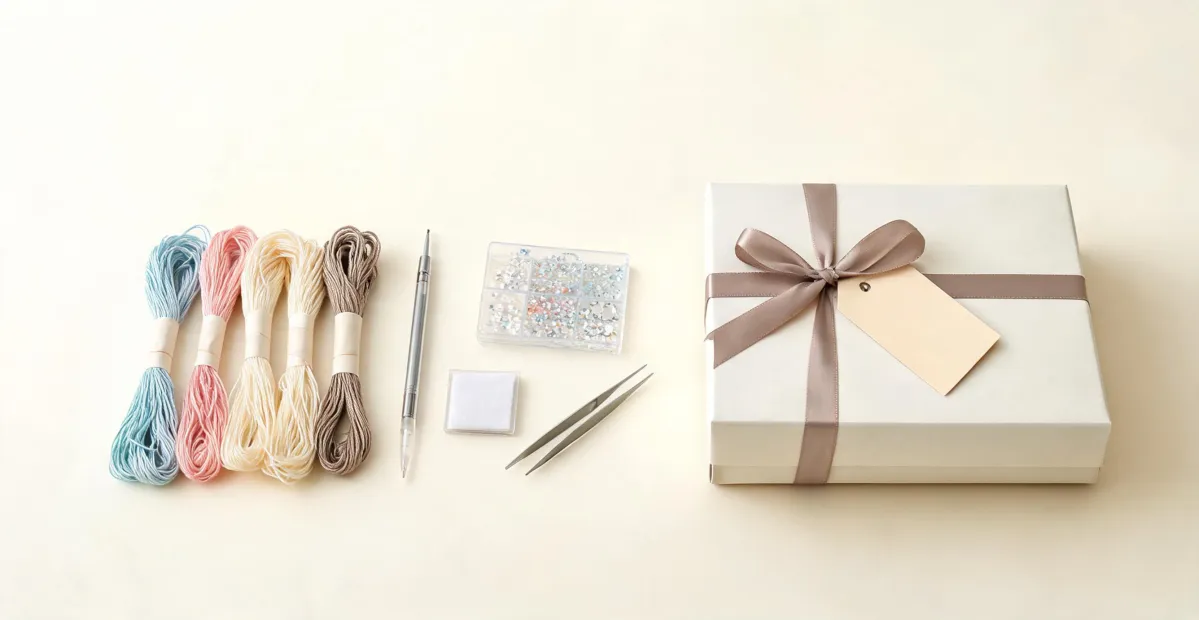
I'll say it plainly: if your company assembles custom embroidery kits or diamond painting sets, choosing lower-priced floss and drills just to hit a savings target is almost never the lowest total cost. That sounds backwards coming from a person whose job is cutting costs. But after six years of tracking purchase orders, I'm convinced the least expensive material is rarely the least expensive option.
I'm a procurement manager at a 40-person promotional products company. We manage a raw-material budget of roughly $180,000 a year, and I keep a line-item cost tracking system for every order — down to the thread, canvas, and tissue paper. So when I say quality isn't a fluffy creative concept, I mean it the same way I mean delivery dates and accounts payable.
The DMC color system is a procurement tool, not just a brand
DMC has been around since 1746, and their standardized color system is the language used in cross stitch magazines, pattern designers, and wholesale spec sheets. If a customer sends us DMC cross stitch patterns, the chart references DMC color numbers. When we buy DMC cross stitch floss, 310 means black, 666 means bright red, and there is zero ambiguity. That is exactly how a purchasing department wants to specify a raw material.
Floss without a documented color standard introduces a variable. The supplier says "close to 310." Sometimes close works. Other times, the dye lot shifts between batches.
In 2023, we ordered 5,000 skeins from an alternative supplier because it was 11 cents lower per skein than DMC. We saved $550 on paper. I went back and forth for a week before approving it. The lower price looked good in a cost-tracking spreadsheet, but my gut said, "don't gamble." My gut was right. The first production run looked acceptable. The second run, from the same supplier, arrived noticeably darker. By then we had already stitched 1,200 kits. Rework cost: $1,400, and we almost missed a delivery to a regional bank chain. I keep the email in a folder named 'lessons.' Actually, I keep it in the same folder as the invoice for the rework.
This isn't an artistic nuance. In an embroidered logo, a color shift is like printing a logo file with the wrong CMYK values. The client approved a DMC reference; what landed in their hands wasn't it. That disconnect kills trust.
The question everyone asks me is, "Couldn't you just test the colors first?" The better question is, "How much time do you want to spend testing every batch?" Color consistency is a spec. DMC makes that spec easy. A non-standardized floss is a gamble where you're the quality inspector.
Diamond painting: saving cents, losing clients
Diamond painting kits are the other half of our catalog. They look like a simple product: a sticky canvas, a tray, and thousands of tiny resin drills. How much can quality matter? It matters more than almost anything else we sell.
In Q2 2024, we compared two suppliers for round 5D drills. One was 12% lower in unit price. The other supplied DMC-branded kits. The lower quote saved $0.34 per kit on a 10,000-unit order — about $3,400. Then the drills arrived with a chemical smell and about 6% were misshapen. We caught it because our QC person opened random bags. If we hadn't, clients would have received kits with gaps in the final picture.
Why does that matter? Because a diamond painting is not a quick craft. It's a 10-hour project. The recipient invests their time in a product that carries your client's logo on the box. If drills don't fit, bubbles form in the canvas, or the adhesive loses grip, the recipient won't blame "the drills." They'll blame the company who gave them the kit.
The hidden cost of a lower-priced diamond painting supplier isn't the $3,400 you saved. It's the canceled follow-up order, the awkward email, and the event where someone says your branded gift was annoying rather than delightful.
The surprising lesson from printing small photos for scrapbooking
Let me bring in an example that seems out of place. One of our best-selling custom promotional gifts is an embroidery kit with a personal photo. We spent months figuring out how to print small photos for scrapbooking, because that's basically what the insert is: a 2×2 inch image on heavyweight paper, treated like a keepsake. It's not a large poster. It's tiny. You'd think any printer can handle it.
We tested lower-cost paper and less-calibrated print profiles. The colors came out muddy, and when our clients wrote notes on the back, the ink bled through. The lower-cost paper saved $18 for 1,000 inserts. The redo, with correct photo printing, cost $260 because we had to reprint, re-ship, and apologize. Now we use a color-accurate ICC profile and bonded paper. That seems like a detail, but it's the difference between a "wow" gift and a "what is this?" gift.
This is the same lesson as DMC floss. The customer is not buying thread, plastic drills, or paper. They are buying a memory, a hobby, a finished piece they want to show off. If the finished piece looks rushed, your brand looks rushed.
But aren't lower-cost materials sometimes fine?
To be fair, not every product needs the top spec. If you're making disposable one-day craft activities, skip the top-shelf floss. Budget constraints are real. I get why people go with the lower-cost option — I've done it when the risk was low.
But for anything brand-facing — a corporate gift, a promotional keep-your-desk item, a client thank-you — you almost never get a second chance at a first impression. The "low-cost materials are fine for promotional products" thinking comes from an era when a disappointed recipient just threw it away. Today, they photograph the finished project, post it on social media, and tell colleagues at lunch. The stakes changed.
I also hear, "Clients don't ask for DMC." True. They don't. They ask for "nice embroidery" and "crystal-clear photos." It's our job to choose the spec that delivers those outcomes. DMC products are a simple way to write "consistent color and reliable quality" into a purchase order.
The math: quality costs a little, rework costs a lot
Let's put rough numbers together for a 1,000-unit custom embroidery kit order. Upgrading to DMC floss and a DMC-numbered pattern chart adds about $0.30–0.50 per kit at bulk pricing. If the kit sells for $8–12, that's 4–6% of the sales price. A single complaint-driven replacement, including return shipping and repacking, usually costs $12–20. To break even, you only need about 2% of the lower-cost option to fail. In practice, floss without a color standard and drills without consistent sizing generate far more than 2% customer-service tickets. The math is not close.
Shipping adds to the hidden cost. According to USPS pricing effective January 2025, First-Class Mail large envelopes start at $1.50 for the first ounce, and each additional ounce is $0.28 (usps.com/stamps). A 4-ounce kit costs $2.34 to mail before packaging. On a $10 kit, shipping is already a quarter of the price. If a color mismatch causes an exchange, you spend another $2.34 on the replacement. Multiply that by 100 unhappy recipients and that $550 savings is gone several times over.
According to USPS pricing effective January 2025: First-Class Mail large envelope (1 oz): $1.50; additional ounce: $0.28. Source: usps.com/stamps.
FTC guidelines (ftc.gov) also require that claims in marketing materials be truthful and substantiated. If you call a kit "premium" while using thread that bleeds and drills that don't align, you're not just disappointing customers — you're creating a legal exposure. That gives me another reason to stick with defensible specs.
My final view
I know a procurement manager's instinct is to squeeze every dollar. Mine is too. But over six years, I've learned that the place to squeeze is overhead, not the visible parts of a gift. Use DMC cross stitch floss for embroidery kits, choose quality drills for diamond painting, and if you're adding a personal photo, learn how to print small photos for scrapbooking with accurate colors and bleed-proof paper.
Your clients will reorder. The ones who don't reorder won't tell you it was because the floss was fraying. They'll just quietly find another supplier. That quiet loss is the one cost that no spreadsheet will ever show you.

Elise Laurent
Elise Laurent is a crystal and decorative glass quality analyst covering crystal figurines, vases, ornaments, suncatchers, and gift glassware. She examines ISO 6486-1 where food-contact glass dinnerware applies, then uses polarized strain inspection, dimensional checks, surface-defect grading, and refractive clarity to compare decorative pieces outside that scope. Her work helps sourcing teams choose materials, finishing routes, and protective packaging without confusing visual brilliance with verified durability.