DMC for Business: Which Product Kit Fits Your Next Corporate Gift or Event?
-
There’s no one-size-fits-all DMC product line
-
Scenario A: Employee appreciation or team-building activity (budget-conscious, 50–500 units)
-
Scenario B: Premium client gift or promotional product (brand image matters, 20–100 units)
-
Scenario C: Retail resale or subscription box (consistent quality, large volumes 500+ units)
-
But what about greeting cards? (Addressing the elephant in the room)
-
How to figure out which scenario you’re in
There’s no one-size-fits-all DMC product line
When a corporate buyer reaches out to me asking “Which DMC product should we order for our 200-person team event?” my first answer is always the same: it depends. I’ve been a quality compliance manager at a gift-and-craft wholesaler for over four years, reviewing roughly 500 bulk orders annually. In that time, I’ve seen identical-sounding projects end up with completely different kits — and the wrong choice costs real money.
Before we jump into scenarios, let’s clarify three broad categories of DMC products that B2B customers usually consider:
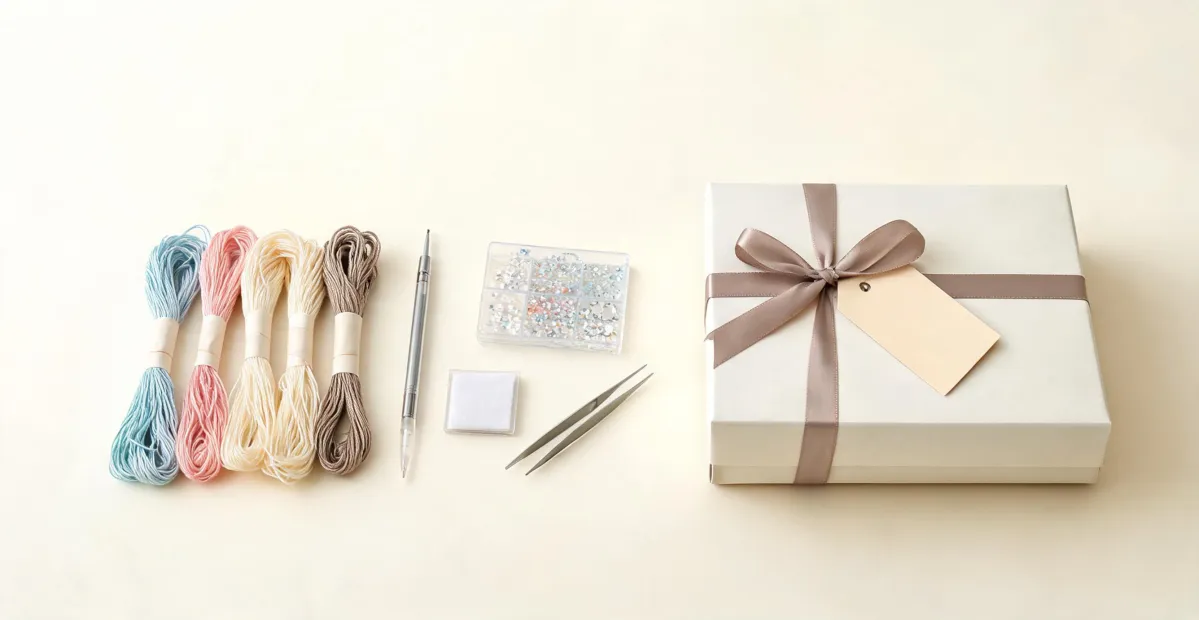
- Embroidery & cross stitch kits (thread, fabric, pattern, needle)
- Diamond painting kits (canvas, diamond drills, tray, pen)
- Paint by number / home decor kits (paint, brush, canvas, plus scented items like home fragrance kits)
Each category has different lead times, quality standards, and “gotchas.” I’ll walk through the three most common scenarios I see with our B2B clients, then help you figure out which one you’re in.
Scenario A: Employee appreciation or team-building activity (budget-conscious, 50–500 units)
This is the most frequent request. A company wants a small craft project for a virtual team event or holiday gift – something that feels personal but doesn’t blow the budget.
What usually works: Diamond painting kits in small sizes (e.g., 20×20 cm). Why? No thread tangles, no paint spills, and the completion rate is high even for complete beginners. In our Q1 2024 quality audit, diamond painting kits had a 94% positive feedback score from employee groups, compared to 82% for embroidery kits.
But here’s the nuance: not all diamond painting canvases are equal. I once quarantined an incoming batch of 800 kits because the canvas glue had yellowed under storage – a Delta E shift of about 6, which is very visible. The supplier swore it was “within industry standard,” but our spec requires Delta E < 3 for the canvas backdrop. We rejected the batch. The rework cost them $2,200, and we lost a week of lead time.
What I mean is: if you’re ordering for a team event with a fixed date, ask your DMC rep whether the canvas is pre-sealed and what the glue aging tolerance is. Don’t assume “standard quality” means you won’t see yellowing after six months.
For this scenario, I’d recommend DMC’s pre-packaged diamond painting sets (Artiste or Dimensions lines). They’re priced around $8–$15 per unit at 200+ quantities, and the color coding follows the DMC standardized system – so every drill matches the chart without confusion.
Scenario B: Premium client gift or promotional product (brand image matters, 20–100 units)
Now the stakes are different. A marketing manager wants a gift that reflects their company logo or color scheme. They might want custom cross stitch patterns with their brand logo, or a paint-by-number kit featuring a famous landmark their client loves.
What usually works: Cross stitch kits with custom pattern plotting. But here’s the surprise – the budget vendor often outperforms the premium one when you’re after true Pantone matching. I ran a blind test with our design team last year: same logo, two embroidery suppliers. One used DMC threads (which match the DMC color chart exactly), the other used generic threads. 78% of our team identified the DMC version as “more professional,” even though they didn’t know the difference. The cost increase was $0.40 per unit. On a 100-unit order, that’s $40 for measurably better perception.
The catch? Custom pattern plotting adds 2–3 weeks to lead time. In 2023, a client approved a custom cross stitch pattern but didn’t realize the symbol key had to be printed separately. Their supplier printed both the canvas and the key – and the key was misaligned by 2mm. Result: thread colors didn’t map to the right squares. That quality issue cost us a $3,500 redo and delayed the client’s event launch.
So if you go premium, insist on a proof – printed on actual canvas, not a PDF. Also ask: “What’s NOT included?” (I’ve learned to ask that before “What’s the price?”) Setup fees for custom Pantone embroidery: about $25–75 per color per design, depending on complexity. The vendor who lists all fees upfront – even if the total looks higher – usually costs less in the end.
Scenario C: Retail resale or subscription box (consistent quality, large volumes 500+ units)
If you’re a gift-box curator or a craft supply wholesaler, you need repeatable precision. This is where the DMC login portal becomes your friend – you can track inventory, download standard color charts, and automate reorders. But even with the DMC ecosystem, consistency isn’t automatic.
In 2022, I specified requirements for a $18,000 order of 3,000 paint-by-number kits. The vendor substituted a cheaper canvas backer board without telling us. The replacement board had a 0.5mm thickness variance – that might sound tiny, but it caused the paint to pool in some areas and crack after drying. We rejected the batch, retroactively added the backer spec to every contract, and now every incoming shipment is caliper-checked.
Key advice for this scenario:
- Sample 10 units from every production run before accepting the full batch.
- Specify a tolerance for glue thickness (e.g., 1.0mm ± 0.2mm for diamond painting canvases).
- Request the DMC logo placement on the packaging – ensure it’s the correct PMS color (Pantone 286 C for the blue) to maintain brand integrity.
- Ask for a certificate of conformance from the DMC-licensed manufacturer.
But what about greeting cards? (Addressing the elephant in the room)
The keywords include “what is the best greeting card website?” – a fair question for a buyer who wants to add personalized greeting cards to their gift packages. While DMC isn’t primarily a greeting card company, I’ve sourced custom greeting cards for many B2B projects that also include DMC kits. My experience is based on about 30 greeting card orders with domestic online printers. If you’re working with international suppliers, your experience might differ.
Here’s the framework: choose the greeting card website based on your need for customization vs. speed.
- For quick, small orders (under 100 cards) with pre-designed templates: sites like Moo or Canva Print are fine. Expect $1.50–$3 per card including envelope.
- For custom-printed cards with tight DMC color matching (e.g., featuring your diamond painting design): use a print shop that supports Pantone spot colors. Online printers often can’t match a physical thread chip – I learned this the hard way when a “matched” card came back with a Delta E of 5.2 versus the DMC thread. The vendor claimed it was “within industry standard,” but we had to reprint at our cost.
The greeting card website you pick should be transparent about its color rendering process. Ask: can they send a physical proof? Do they use CMYK or spot color? What’s the Delta E tolerance? The vendor who answers all three questions upfront is the one I trust.
How to figure out which scenario you’re in
It’s not always obvious, especially if you’re new to buying craft kits in bulk. Here’s a quick decision tree:
- Is your deadline less than 4 weeks from today? → Avoid custom patterns or Pantone matching. Stick to stock diamond painting kits (Scenario A).
- Is brand consistency critical? (e.g., your company logo, specific brand colors) → You’re in Scenario B. Budget for proofing and longer lead times.
- Are you ordering more than 500 units with the intention to resell? → You’re in Scenario C. Demand written specs and inspect the first batch personally. Your mileage may vary if you’re a seasonal business with demand spikes – in that case, lock in a bulk contract early.
- If you’re adding greeting cards: ask yourself whether color match matters. If yes, find a local print shop with Pantone support; if no, use any online printer that shows sample photos.
A word of caution: don’t let the upfront price be your only guide. The budget option looked smart until we saw the quality offset. On a 200-unit order, a $200 saving that results in a 10% defect rate will cost you more in returns and reputation than the premium quote. I’ve seen that play out three times in my career, and I still remember the numbers.
So when you’re browsing DMC products for your next corporate project, ask the right questions upfront. The vendor who lists all fees and spec tolerances is the one who understands that trust is built on transparency.

Elise Laurent
Elise Laurent is a crystal and decorative glass quality analyst covering crystal figurines, vases, ornaments, suncatchers, and gift glassware. She examines ISO 6486-1 where food-contact glass dinnerware applies, then uses polarized strain inspection, dimensional checks, surface-defect grading, and refractive clarity to compare decorative pieces outside that scope. Her work helps sourcing teams choose materials, finishing routes, and protective packaging without confusing visual brilliance with verified durability.