Craft Kits for Corporate Gifts: How DMC's Color Chart Saved My Order (and Why Needlepoint Isn't Cross Stitch)
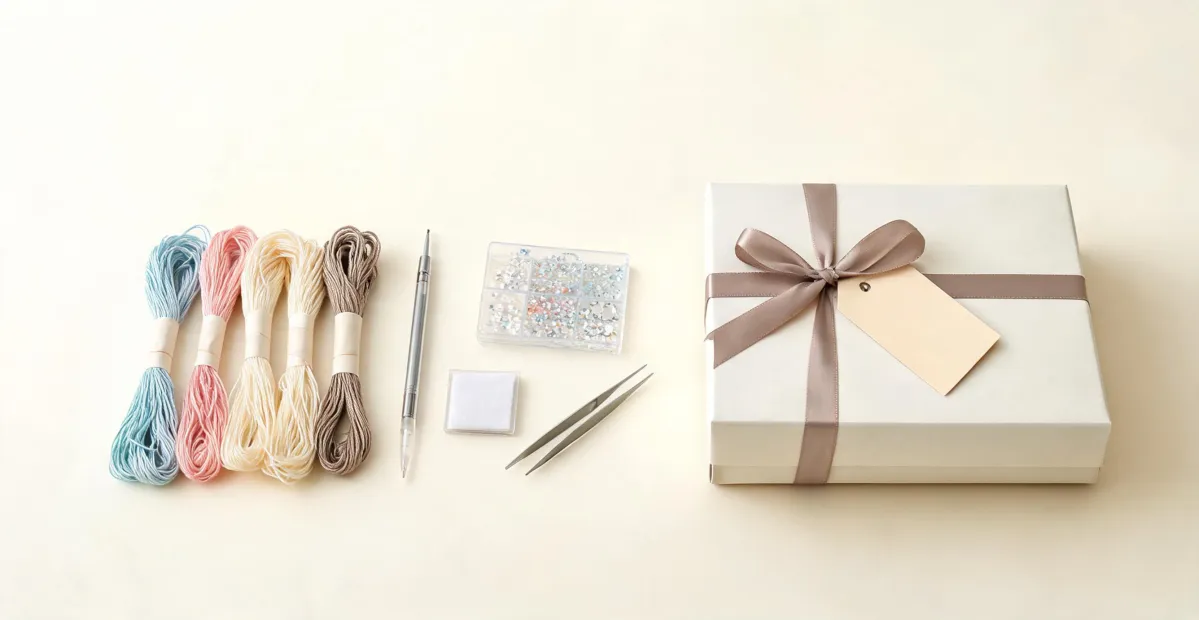
In early November 2024, my VP of HR walked into my office with a request that changed how I think about corporate gifts: "We need something employees will actually use. Not another branded water bottle."
That conversation sent me down a two-month rabbit hole. I'm not a crafter. I hadn't touched a needle since a middle school home economics class. But as the office administrator for a 400-person company, gift purchasing falls to me. So I did what I always do: made a spreadsheet and started hunting.
The Assignment That Started It All
Our annual holiday gift program covers all three locations. Previous years had been safe. Insulated mugs. Power banks. A desk succulent that died in most offices by February (note to self: never buy living things again).
This year, someone on the employee engagement team suggested DIY craft kits. Embroidery. Diamond painting. Paint by number. The logic was sound: people are burned out, and a hands-on activity gives them a screen break with something to show for it.
The problem? I knew nothing about craft supplies. Nada. Zero.
But I knew how to research. And when I started digging, I found DMC.
Discovering DMC (a Brand That's Older Than Most Countries)
According to DMC's official website (dmc.com), the company was founded in 1746 in Alsace, France.
That's 279 years of continuous operation. They started as a textile company and grew into one of the most recognized names in embroidery, needlework, and craft kits.
The dmc shop carries an enormous range: embroidery kits, cross stitch supplies, diamond painting accessories, paint by number kits, home decor, and even home fragrance products like candles and room sprays.
For a corporate buyer, the breadth was appealing. One supplier for multiple gift categories. But the real value—the thing I nearly missed—was the color system.
The First Problem: Color Mismatch
My first instinct was to mix and match. A few embroidery kits here. A few diamond painting kits there. Both from DMC, so they should look cohesive together, right?
Not exactly.
I ordered samples in early November. When they arrived, I laid out an embroidery kit and a diamond painting kit side by side. The red thread in the embroidery kit didn't match the red diamond chips in the painting kit. Close. Not identical.
For most people, probably fine. For me? It drove me crazy.
Then I learned about the DMC color chart.
The DMC Color Chart for Diamond Painting (and Everything Else)
Here's how DMC's system works. Every color in the DMC universe has a specific code—a number that corresponds to a precise formula. Thread, yarn, fabric, diamond painting resin chips, all of them use the same reference system. A "DMC 310" is black. A "DMC 666" is a specific bright red. The code means the same thing across every product line (Source: DMC color card, dmc.com, accessed December 2024).
For diamond painting specifically, this is a game-changer. Diamond painting kits come with a canvas printed with symbols. Each symbol maps to a DMC color code, and the resin diamonds are labeled accordingly. It creates a universal language.
People assume brands like DMC charge premium prices because of name recognition. Actually, the premium pays for standardization and quality control. The colors are consistent because they're manufactured to exact tolerances. The causation runs the other way: they've earned the premium by delivering accuracy you can verify.
From a procurement perspective, that meant spec'ing a color code was like writing a technical requirement. I could tell the dmc shop "we need kits with DMC 470, 820, and 996" and expect consistency. No guessing games.
Wait, What About the Home Fragrance Line?
One thing I found surprising was the home fragrance collection. Candles, scented sachets, room sprays—it seemed like an odd addition to a craft brand. But the logic became clear: their customers are people who like creating a pleasant home environment. The craft is the activity; the fragrance is the ambiance. Smart cross-sell, honestly.
We didn't include home fragrance in our gift package this year—budget was tight, and the kits themselves were substantial. But it's on my list for future programs.
Is Needlepoint the Same as Cross Stitch?
During my research, I kept seeing the same question everywhere: "is needle point the same as cross stitch?" It's one of the most common queries in the craft space.
Short answer: no. They're different techniques, and confusing them leads to ordering the wrong product.
Cross stitch uses fabric with an even, visible grid (often Aida cloth). Each stitch is an X-shaped mark in one square of the grid. The pattern is created by dozens, hundreds, or thousands of these Xs. It's structured, forgiving, and excellent for beginners.
Needlepoint is a different animal. Instead of X stitches, it uses tent stitches—diagonal, slanted stitches that cover the canvas completely. The canvas is often a stiff, open-weave material, and the finished result is dense and plush. Needlepoint is generally more time-consuming and requires more skill.
The misconception happens because both are "needle on fabric" crafts, and some retailers use the terms interchangeably. That's misleading.
I'm not an expert in either craft, so I can't speak to the nuances of thread counts or canvas types. What I can tell you from a purchasing perspective is that cross stitch kits are the better introductory gift for a mixed group. The grid makes it virtually impossible to ruin. Needlepoint is better for experienced crafters—a smaller segment of most companies.
The Order: What Worked, What Didn't
By early December, we finalized the details. Our order from the dmc shop included:
- 200 diamond painting kits (frankly, the most visually striking option)
- 120 cross stitch kits for beginners
- 80 paint by number kits as an alternative for painting fans
Each kit included a color chart card. Pricing ranged from $12 to $35 per unit, depending on size and complexity (based on dmc shop bulk quotes, November 2024; verify current pricing—rates may have changed). Total: roughly $4,200.
Delivery was smooth. Three batches over two weeks, all accounted for. No missing parts, no damaged boxes. That's the level of reliability you'd expect from a 279-year-old company.
But here's where I stumbled.
The 15% Problem
When we distributed the kits, about 85% of employees were genuinely happy. Some were even thrilled—the diamond painting kits sparked a small Slack community that shared photos daily.
The other 15%? Not interested. Some just put the kits in a drawer. A few told me directly, "Crafting isn't my thing."
I realized too late that I had never actually asked our employees what they wanted. I had relied on the engagement team's suggestion and my own research.
Looking back, I should have run a quick survey—a single Google Form would have taken 2 days, not 2 weeks, and it would have told me that a meaningful minority wouldn't touch a craft kit. But given the deadline pressure and the enthusiasm from the engagement team, the decision was a reasonable leap.
The upside: for the 85% who engaged, the gift was a standout success. The cross-stitch channel in Slack became the most wholesome corner of the entire company. The risk: wasted budget on that disinterested 15%. I kept asking myself whether the engagement boost was worth the waste. For this company, with this culture, yes. I'd still do it again.
Lessons for Anyone Buying Craft Products in Bulk
If you're considering craft kits for your organization—or for any group, really—here's what I learned:
- Use DMC color codes as your specification language. It's a procurement tool disguised as a craft accessory. You can spec exactly what you need.
- Know the difference between crafts before ordering. Cross stitch is beginner-friendly. Needlepoint is for the experienced. Diamond painting is its own unique experience. Match the craft to your audience.
- Survey your recipients first. Five minutes of asking saves five hundred dollars of guessing. I'll never skip this step again.
- Read the kit contents carefully. Some kits include everything (fabric, thread, needle, hoop). Others assume you already own tools. The dmc shop's product descriptions are accurate, but not every retailer is.
Final Thoughts
This project turned out well, despite my early missteps. The DMC color chart made the inventory manageable. The product range covered our needs. And the kits genuinely improved morale in a way branded merchandise never did.
Would I recommend DMC for corporate gifting? Yes. But I'd recommend asking your people first, even more strongly than I'd recommend the products.
And for anyone still wondering: needlepoint and cross stitch are not the same. Separate categories, separate techniques, separate audiences. Now you know what to order.
(I really should write that procurement checklist into a standard operating procedure. Mental note for Q1.)

Elise Laurent
Elise Laurent is a crystal and decorative glass quality analyst covering crystal figurines, vases, ornaments, suncatchers, and gift glassware. She examines ISO 6486-1 where food-contact glass dinnerware applies, then uses polarized strain inspection, dimensional checks, surface-defect grading, and refractive clarity to compare decorative pieces outside that scope. Her work helps sourcing teams choose materials, finishing routes, and protective packaging without confusing visual brilliance with verified durability.