5 Steps to Order Employee Gifts Without the Headache (An Admin‘s Checklist)
-
What This Checklist Is For (And Who Needs It)
-
Step 1: Define the Gift’s Purpose (Before You Look at Products)
-
Step 2: Set a Budget That Includes the Invisible Costs
-
Step 3: Choose Products That Fit Your Team (Not Just Your Catalog)
-
Step 4: Verify the Supplier’s B2B Capabilities (Don’t Assume)
-
Step 5: Plan the Delivery Logistics (Especially for Multiple Locations)
-
Common Pitfalls (And How to Avoid Them)
What This Checklist Is For (And Who Needs It)
If you’re the person in charge of ordering holiday gifts, welcome rewards, or team-building kits for your company—this is for you. I’m an office administrator for a mid-size firm, and I’ve managed roughly $80,000 annually in employee and client gifting across 8 vendors since 2022.
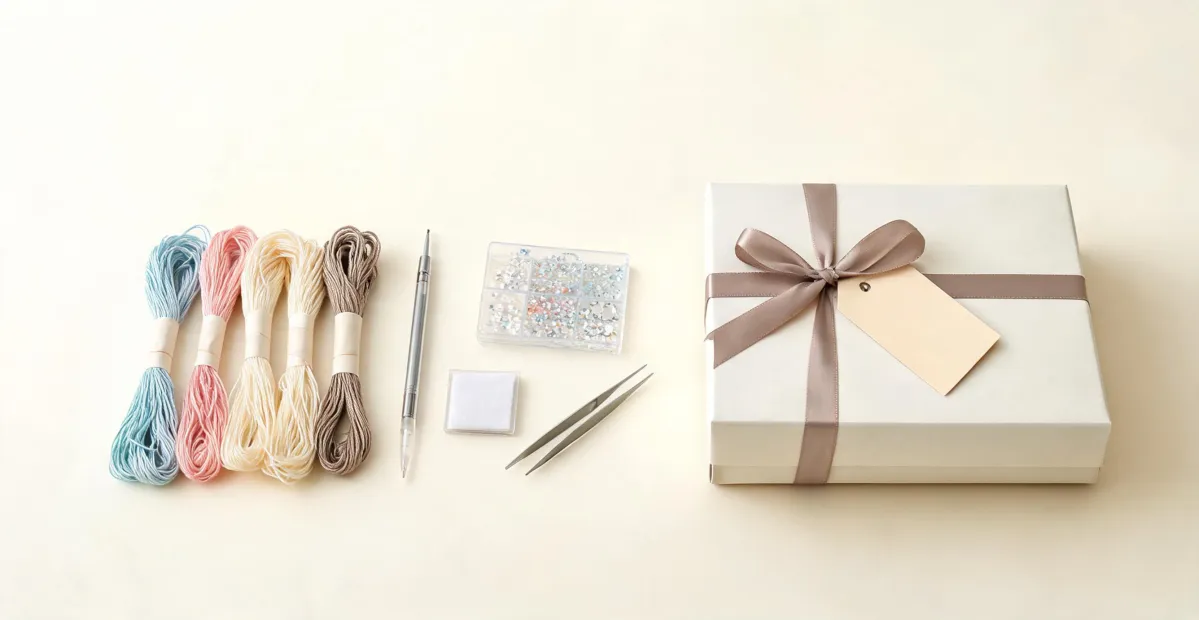
This checklist is designed for B2B buyers who need to order custom or branded gifts—things like embroidery kits, diamond painting sets, home fragrance, or personalized home decor—without the typical pain points: late deliveries, quality mismatches, or surprise costs. It covers 5 steps, plus a few pitfalls I’ve learned the hard way.
Step 1: Define the Gift’s Purpose (Before You Look at Products)
Most buyers jump straight to browsing catalogs. That’s a mistake. The single most overlooked factor is why you’re giving the gift.
Ask yourself:
- Is this for a holiday appreciation pack? (Then variety matters, and people will compare.)
- A team-building event? (Then a single activity kit, like a cross-stitch or paint-by-number set, works better.)
- A new hire welcome gift? (Then it should be small, branded, and easy to ship.)
- A client thank-you? (Then perceived value and packaging matter more than count.)
In my experience, the “one-size-fits-all” gift box ends up costing more because you’ll get complaints from people who don’t craft, don’t want another candle, or already have similar items. Match the intent to the product category—and write that down before you contact any supplier.
Step 2: Set a Budget That Includes the Invisible Costs
Most buyers focus on per-unit pricing and completely miss setup fees, customization charges, shipping, and potential rush premiums that can add 30–50% to the total. The question everyone asks is “what’s your best price?” The question they should ask is “what’s included in that price?”
Build your budget line by line:
- Product cost (per unit)
- Customization or branding fees (e.g., logo embroidery, label printing)
- Packaging (if you want custom boxes or tissue)
- Shipping (especially if going to multiple locations)
- Rush fees (if you’re cutting it close—which, honestly, we often do)
In our 2024 year-end project, a vendor quoted $12 per kit. After adding logo embroidery ($2.50/unit), custom boxes ($1.80/unit), and split shipping to 3 offices, the actual cost was $18.20 per unit. That’s a 52% markup over the base price. I now ask for a total landed cost breakdown before comparing quotes.
Step 3: Choose Products That Fit Your Team (Not Just Your Catalog)
You can pick the prettiest embroidery kit or the most elegant home decor item, but if your team doesn’t use it, it’s wasted money. Here’s the mistake I made in 2023: I ordered 200 “premium” cross-stitch kits for a holiday gift. Turned out only about 30% of our staff actually does needlework. The rest ended up in a drawer or regifted.
Better approach:
- Send a quick poll (even informal Slack message) to gauge interest in DIY vs ready-to-use items
- Offer a choice between 2–3 categories: e.g., craft kit, home decor item, or home fragrance set
- If you must order one item, go for something broadly appealing: a paint-by-number set (low skill barrier) or a nice scented candle with a brand label
One thing I’ve started doing: ordering a small test batch—say 10 units—before committing to 200. Yes, it costs a bit more upfront, but it saved me from ordering 200 units of a kit that had confusing instructions (thankfully caught it early).
Step 4: Verify the Supplier’s B2B Capabilities (Don’t Assume)
I’ve been burned by this twice. A vendor looked great online—great product photos, decent reviews. But when I needed branded packaging, a bulk discount, and a proper invoice for accounting, they couldn’t deliver. One couldn’t even provide a standard PO-friendly invoice (handwritten only). Finance rejected the expense report. I ate $800 out of my department budget.
Before ordering, confirm these three things:
- Do they accept purchase orders? (Not just credit cards? Very common gap.)
- Can they provide net 30 terms? (For larger orders, this is standard.)
- Do they have a dedicated B2B sales or customer service contact? (Not just a general email.)
These three questions filter out 60% of consumer-focused vendors. If they can’t answer yes, move on. The headache isn’t worth the savings.
Step 5: Plan the Delivery Logistics (Especially for Multiple Locations)
Even after choosing the product and vendor, I kept second-guessing the logistics. What if the shipments arrived late for different offices? The two weeks until delivery were stressful. Don’t assume one shipment covers everything.
Logistics checklist:
- Confirm shipping timelines: how many business days from order to delivery?
- Can they ship to multiple addresses? (Not every supplier offers split shipments.)
- What’s the cost per additional location? (Sometimes consolidating and repacking yourself is cheaper.)
- Is there a delivery signature required? (If your office isn’t staffed on weekends, that’s a problem.)
For our 2024 Valentine’s gift pack, we had employees working remote across 4 states. We used the vendor’s bulk shipment to one central office, then I contracted a courier for the last-mile to individual homes. The vendor’s per-unit shipping was $6.50; the courier cost $3.80 per address. Saved about $1,200 total. (Finally! A win.)
Common Pitfalls (And How to Avoid Them)
Pitfall #1: Ordering based on samples without checking the production run.
I once approved a beautifully embroidered sample—then the production batch had noticeably thinner thread. Always request a “pre-production sample” from the actual production run, not a handcrafted prototype.
Pitfall #2: Ignoring the return or reject policy.
Some B2B suppliers won’t accept returns on custom items—and sometimes that’s fair. But you should at least know the defect rate they guarantee. I now ask: “If 5% are defective, what’s the process?” If they can’t answer clearly, walk away.
Pitfall #3: Forgetting customs and duties.
If your vendor is overseas (common for embroidery and home decor), factor in potential duties. I had a $3,500 shipment held at customs for 10 days because the paperwork wasn’t right. The delay cost us more than the duty itself.
Pitfall #4: Relying on verbal promises.
Get every deadline, spec, and cost in writing. I don’t mean to sound cynical, but after five years of doing this, I’ve learned that verbal “no problem” means “we’ll try.” Written commitments hold up better when something goes wrong.
Pitfall #5: Not testing the unboxing experience.
This matters for client gifts especially. If the kit arrives in a crushed box or with missing parts, you lose the goodwill you were trying to build. Request a sample of the final packaged product—not just the product itself.
That’s it. 5 steps, 5 pitfalls. Follow this, and your next batch of employee or client gifts won’t end up as a painful lesson. (Hopefully.)

Elise Laurent
Elise Laurent is a crystal and decorative glass quality analyst covering crystal figurines, vases, ornaments, suncatchers, and gift glassware. She examines ISO 6486-1 where food-contact glass dinnerware applies, then uses polarized strain inspection, dimensional checks, surface-defect grading, and refractive clarity to compare decorative pieces outside that scope. Her work helps sourcing teams choose materials, finishing routes, and protective packaging without confusing visual brilliance with verified durability.